Med Spa EMR vs Practice Management Software: What’s the Difference?
When evaluating technology for a med spa, two terms frequently appear: EMR software and practice management software.
They are related, but they are not the same thing.
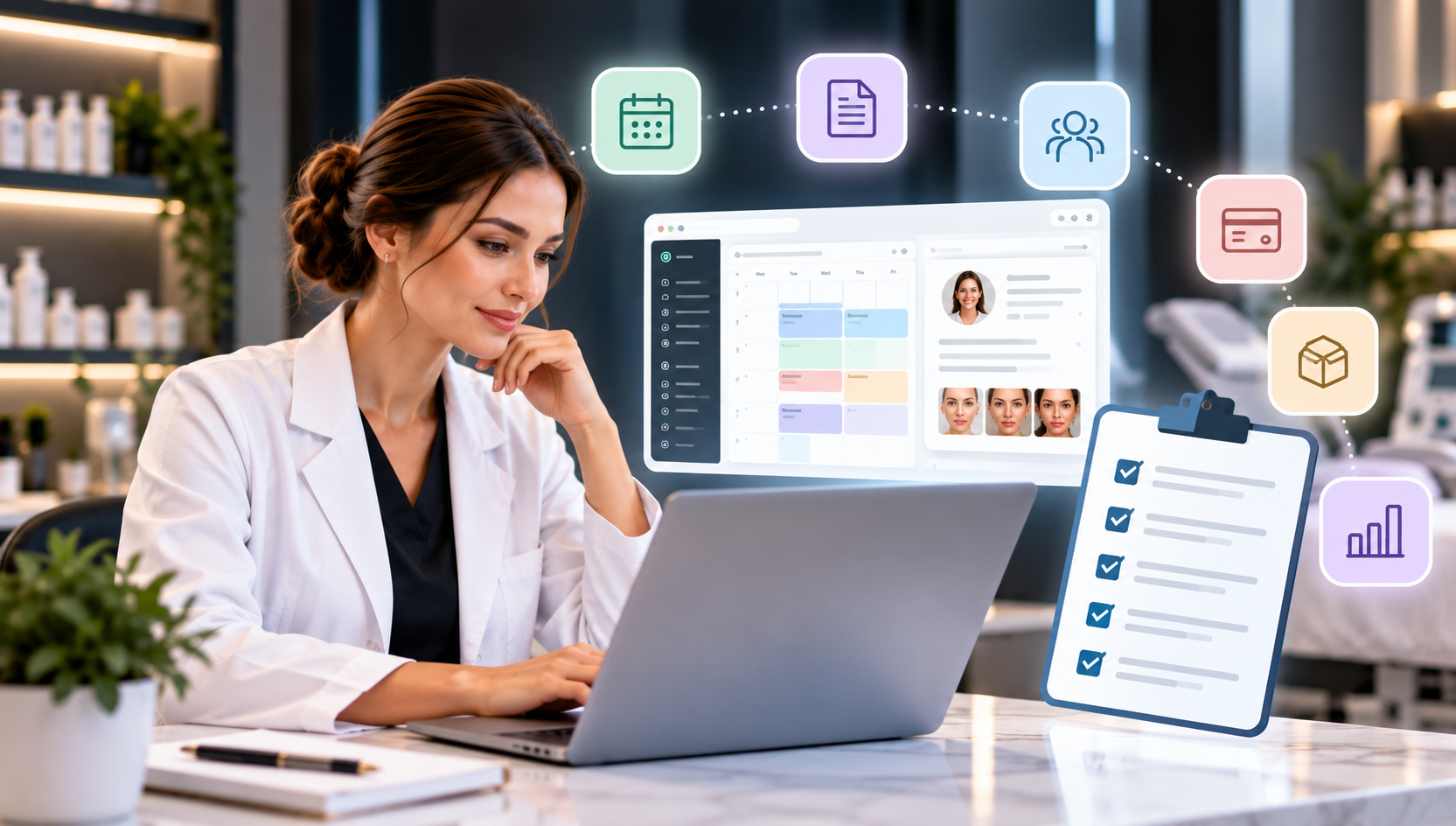
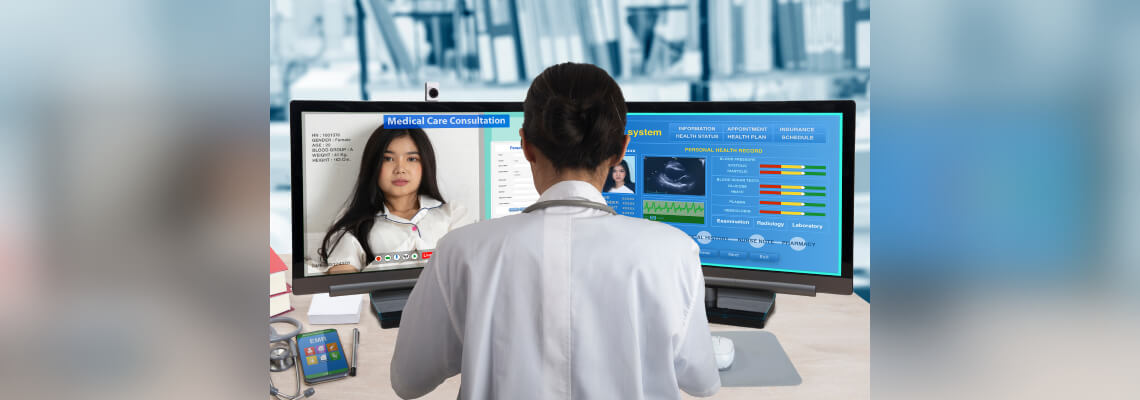
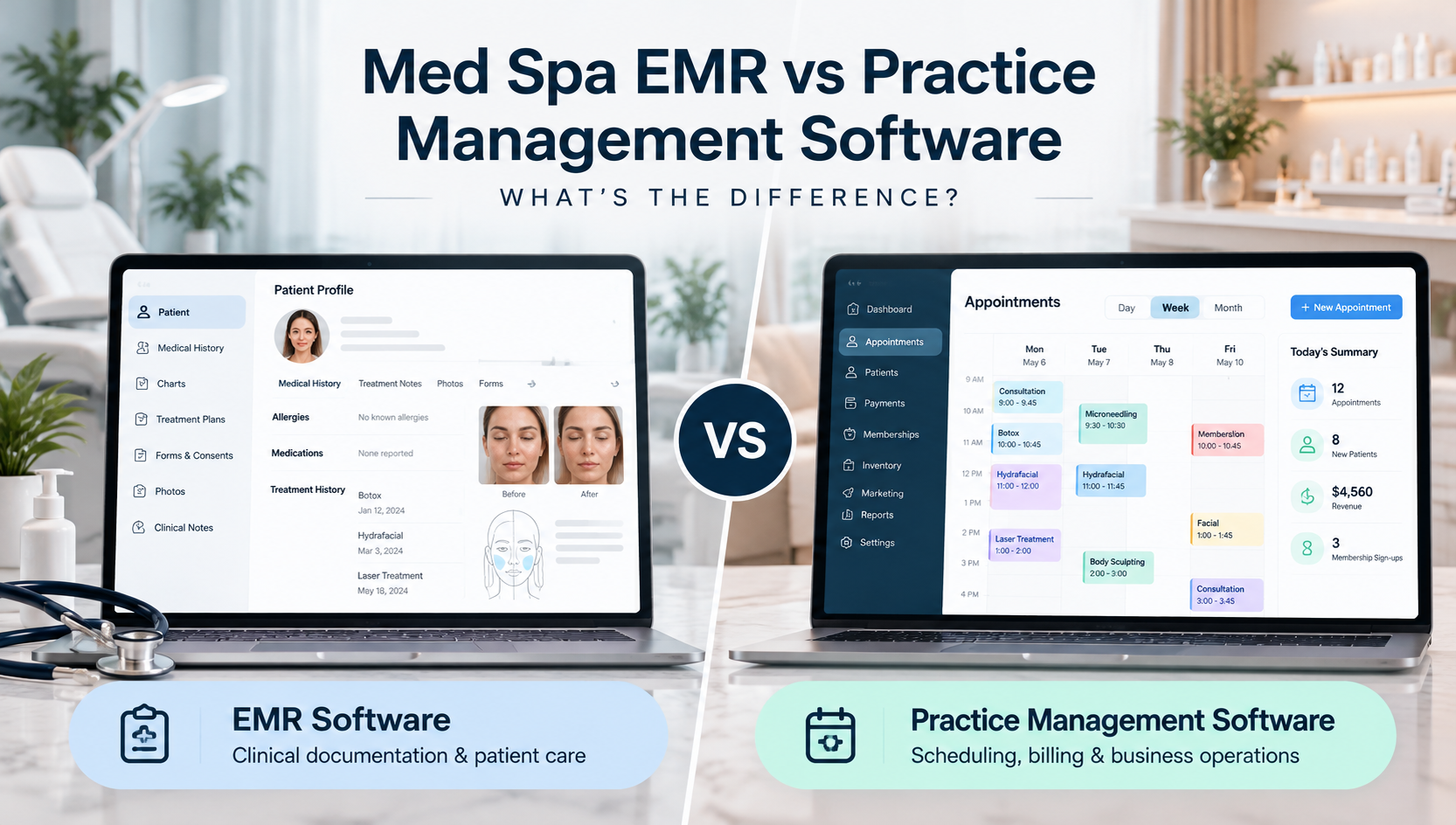
An Electronic Medical Record (EMR) primarily supports the clinical side of patient care, including patient histories, treatment documentation, notes, forms, and other medical records. Practice management software generally focuses on the administrative and operational side of running the practice, such as scheduling, communications, billing, payments, memberships, and reporting.
For a modern med spa, however, these workflows often overlap. A patient can move from booking to intake, consultation, treatment, documentation, checkout, and follow-up during a single journey.
Understanding the difference between EMR and practice management software—and how the two can work together—can help med spa owners choose technology that better supports their practice.
What Is Med Spa EMR Software?
A med spa EMR is an electronic system used to organize and maintain patient medical and clinical information.
Unlike a basic customer database, an EMR is designed around clinical documentation. Depending on the platform and practice requirements, it may contain information such as:
- Patient demographics
- Medical history
- Allergies and medications
- Previous visits
- Clinical notes
- Treatment history
- Treatment plans
- Questionnaires and consent forms
- Before-and-after photographs
- Procedure documentation
For aesthetic practices, the ability to document treatments visually can also be important. Some systems provide charting or drawing capabilities that allow providers to record treatment areas and other relevant procedure information.
The primary purpose of an EMR is therefore to help authorized users maintain and access the clinical record associated with the patient.
What Is Med Spa Practice Management Software?
Med spa practice management software has a broader operational focus.
It helps manage the business and administrative workflows involved in operating a med spa.
Depending on the platform, practice management functionality can include:
- Appointment scheduling
- Online booking
- Patient management
- Check-in and checkout
- Phone and SMS communication
- Appointment reminders
- Billing and payments
- Membership management
- Product management
- Inventory
- Staff and provider scheduling
- Reporting
- Multi-location operations
Think of practice management software as the operational infrastructure surrounding the patient visit.
The EMR helps answer:
“What clinical information do we need for this patient and this treatment?”
Practice management software helps answer:
“How do we manage the operational journey surrounding this appointment?”
Med Spa EMR vs Practice Management Software at a Glance
| Capability | EMR Software | Practice Management Software |
|---|---|---|
| Patient medical history | ✓ | May integrate/include |
| Allergies and medications | ✓ | May integrate/include |
| Clinical notes | ✓ | May integrate/include |
| Treatment documentation | ✓ | May integrate/include |
| Consent forms | ✓ | May integrate/include |
| Before-and-after photos | Often | May include |
| Treatment plans | Often | May include |
| Appointment scheduling | Limited/varies | ✓ |
| Online booking | Limited/varies | ✓ |
| Patient communication | Limited/varies | ✓ |
| Billing and checkout | Limited/varies | ✓ |
| Memberships | Usually not core | ✓ |
| Inventory | Varies | Often |
| Business reporting | Limited | ✓ |
| Multi-location management | Varies | Often |
The exact capabilities vary significantly between vendors. Some modern platforms combine both categories, which is why evaluating actual workflows is more useful than relying only on product labels.
Why Med Spas Often Need Both
A med spa operates at the intersection of healthcare, aesthetics, hospitality, and business operations.
Consider a typical patient visit.
1. Appointment
The patient schedules an appointment online or through the front desk.
2. Intake
Relevant patient information, questionnaires, and forms are collected.
3. Check-In
Staff confirms the appointment and prepares the patient for the provider.
4. Clinical Review
The provider reviews relevant medical information, previous visits, photographs, notes, and treatment history.
5. Treatment
The provider performs the service and documents appropriate information.
6. Checkout
The practice processes the current sale, payment, applicable membership benefits, products, or promotions.
7. Follow-Up
The patient may receive appropriate instructions, reminders, surveys, or other communications.
The clinical and administrative portions are different, but the patient experiences them as one journey.
That is why the relationship between EMR and practice management software matters.
The Problem With Disconnected Systems
A practice can use one EMR and a completely separate practice management system. In some cases, that approach may be appropriate.
The challenge appears when important information does not move efficiently between systems.
Staff may need to:
- Search for the same patient in multiple platforms
- Enter information more than once
- Move between separate scheduling and clinical systems
- Check another application for communication history
- Reconcile information during billing or checkout
The issue isn't necessarily the number of applications being used. It is the amount of manual work required between them.
When evaluating separate systems, med spa owners should therefore examine the quality of the integrations and determine exactly what information moves between platforms.
The Advantage of Connected Clinical and Operational Workflows
Another approach is to use a platform where EMR and practice-management functionality operate within the same ecosystem.
Instead of viewing the workflow as:
Scheduling Software → EMR → Communication Platform → Payment System
a connected environment can support a journey closer to:
Booking → Check-In → Patient Profile → Clinical Documentation → Treatment → Checkout → Follow-Up
This can provide staff with better continuity as the patient moves through the practice.
For example, the provider may be able to review information collected earlier in the patient journey without rebuilding the patient's context. After treatment, the workflow can move toward billing and checkout without requiring staff to start again in an unrelated system.
The objective is not simply to put more features into one application. The value comes from how those features work together.
What Should You Look for in a Med Spa EMR?
If clinical documentation is a major priority, examine the EMR portion carefully.
Consider whether it supports the types of records and workflows your providers actually need.
Questions to ask include:
Can providers quickly review relevant patient information?
The patient profile should make important information accessible without unnecessary searching.
Does it support appropriate treatment documentation?
Look at notes, treatment history, treatment plans, photographs, forms, and procedure-specific documentation relevant to your practice.
Can you manage questionnaires and consents?
Determine how completed documents are stored and connected to the patient.
How does the provider move through a visit?
Ask the vendor to demonstrate the workflow from opening the patient record through completing documentation.
A long feature list is less important than whether providers can use those capabilities efficiently during a real appointment.
What Should You Look for in Practice Management Software?
For the operational side, evaluate how well the software supports activities before and after the clinical encounter.
Important areas can include:
Scheduling and Booking: Can staff manage providers, appointment types, availability, cancellations, and online booking?
Patient Communication: Can relevant calls, SMS messages, reminders, and appointment interactions stay connected with the workflow?
Billing and Payments: How does the practice move from a completed treatment into checkout?
Memberships: Can staff manage membership status and applicable benefits?
Inventory: Can products and relevant inventory activity be monitored?
Reporting: Can owners and managers understand important operational activity?
Scalability: Can the system support additional staff, providers, and locations as the practice grows?
Again, ask vendors to demonstrate these processes rather than simply confirming that a feature exists.
Do You Need Two Separate Systems?
Not necessarily.
Some practices choose separate EMR and practice-management platforms because they have specific requirements or already rely on specialized systems.
Others prefer an integrated platform that combines clinical and operational capabilities.
Neither approach should be evaluated purely on the number of applications.
Instead, ask:
How much manual work exists between systems?
Is important information available where staff need it?
Can providers efficiently move through clinical documentation?
Can the front desk efficiently manage appointments, communication, and checkout?
Can the technology support future growth?
If separate systems integrate effectively and support the practice's requirements, they may work well. If fragmentation creates unnecessary administrative work, a more unified approach may be worth considering.
Where Does AI Fit?
AI is increasingly being incorporated into both clinical-support and practice-management workflows.
On the administrative side, AI may assist with common inquiries, appointment-related conversations, patient intake, SMS interactions, or other routine workflows.
On the clinical side, AI-assisted tools may help organize information or prepare documentation drafts for appropriate provider review.
The important consideration is not simply whether software offers “AI.”
Med spa owners should ask:
- What does the AI actually do?
- What information can it access?
- How does it connect with scheduling or patient records?
- When is staff intervention required?
- Where is provider review required?
- How is sensitive information handled?
AI can be more useful when it works within established workflows instead of becoming another disconnected application.
How DigiMEDSPA Connects EMR and Practice Management
DigiMEDSPA is designed to bring clinical and operational workflows into a connected environment.
Its EMR capabilities support areas such as patient profiles, medical information, notes, photographs, treatment plans, questionnaires, consents, and clinical documentation.
Around the clinical workflow, DigiMEDSPA also provides practice-management capabilities for areas including scheduling, patient communication, billing, payments, memberships, products, inventory, and reporting.
This creates a workflow in which key stages can remain connected:
Appointment → Check-In → Patient Record → Treatment → Documentation → Billing → Checkout → Follow-Up
DigiMEDSPA also provides AI capabilities that can support selected administrative and documentation workflows within the broader platform.
Rather than choosing between an EMR and practice management system, practices can evaluate whether a connected platform can support both sides of their operation.
EMR vs Practice Management Software: Which Does Your Med Spa Need?
For many medical aesthetic practices, the answer is both capabilities.
An EMR supports the clinical record and documentation surrounding patient care.
Practice management software supports the administrative and business processes surrounding that care.
The real decision is whether your practice should use separate systems or a platform that connects both.
When comparing options, focus on your actual patient journey:
How does a patient book?
How does staff collect information?
How does the provider document treatment?
How does the patient check out?
How does the practice follow up?
Software should make those transitions easier—not create additional work between them.
For med spas evaluating their technology stack, understanding this distinction is an important first step toward choosing a system that can support both patient workflows and practice operations.
Frequently Asked Questions
Is an EMR the same as practice management software?
No. An EMR primarily focuses on patient medical records and clinical documentation. Practice management software generally supports administrative and operational functions such as scheduling, communication, billing, payments, memberships, and reporting. Some platforms combine both.
Does a med spa need an EMR?
The appropriate technology depends on the practice's services, providers, documentation requirements, applicable regulations, and workflows. Practices should evaluate their specific clinical and legal requirements when selecting systems.
Can practice management software include an EMR?
Yes. Some med spa management platforms include EMR capabilities as part of a broader practice-management ecosystem.
What is the benefit of connecting an EMR with scheduling?
Connecting clinical and scheduling workflows can make relevant patient and appointment information more readily available as staff and providers move through the patient journey.
Is all-in-one med spa software better than separate systems?
Not automatically. The right approach depends on the practice's requirements. When comparing options, consider integrations, workflow efficiency, clinical capabilities, security, scalability, implementation, and how much manual work is required between systems.
Bring Clinical and Practice Management Workflows Together
A med spa shouldn't have to choose between understanding its patients and efficiently managing its operations.
DigiMEDSPA connects EMR, scheduling, patient management, communication, billing, and other key practice workflows within one platform.
Book a Demo to See How DigiMEDSPA Works