
How to Turn More Med Spa Website Visitors Into Appointment Requests
A med spa website can attract visitors through Google Search, social media, advertising, referrals, and other marketing channels.
But website traffic alone does not guarantee appointment requests.
A prospective patient may visit your website, explore a treatment page, review your clinic information, and leave without taking the next step.
For med spa owners, the goal should be to create a website that helps visitors find relevant information, understand their options, and contact the practice when they are ready.
Improving med spa website conversion involves more than changing button colors or adding promotional banners. It requires a clear, trustworthy, mobile-friendly experience connected to a reliable inquiry and booking process.
What Is Med Spa Website Conversion?
Website conversion refers to a visitor completing a desired action.
For a medical spa, this may include:
- Booking an appointment
- Requesting a consultation
- Submitting a contact form
- Calling the practice
- Requesting a callback
- Starting an online booking process
Not every visitor will be ready to schedule immediately.
Some are researching treatments, comparing providers, or looking for basic information.
A well-structured website should support these different stages without making the next step difficult to find.
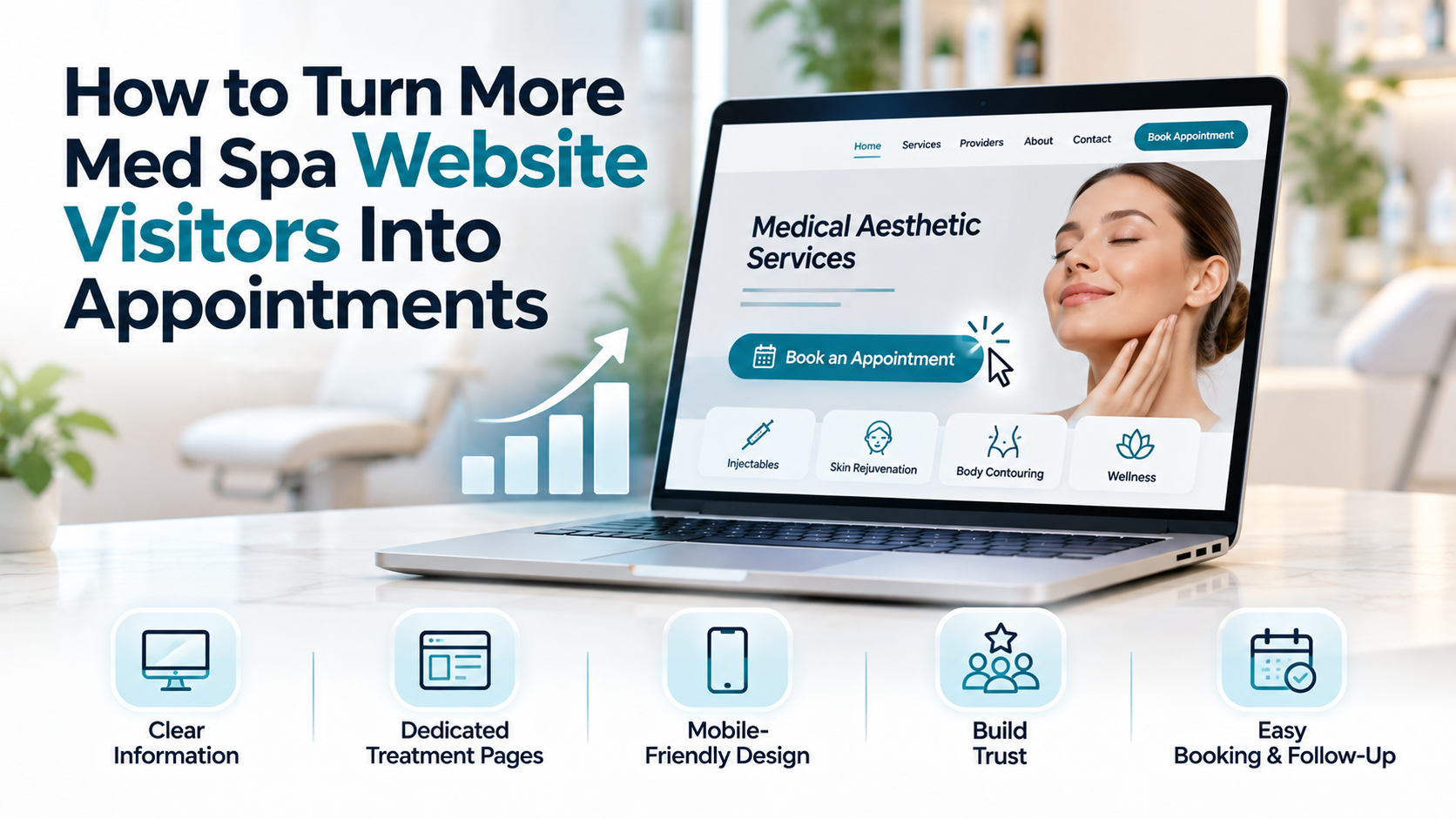
1. Make Your Website's Purpose Clear
Visitors should quickly understand who your practice serves, which services you offer, and where you are located.
A homepage should communicate essential information without requiring visitors to search through multiple sections.
For example, a med spa homepage might prominently display:
Medical Aesthetic Services in [City, State]
Followed by a concise description of the practice and clear navigation to treatments, providers, and appointment options.
Avoid vague headlines that sound appealing but provide little information about the business.
Clarity is particularly important for visitors arriving from local Google searches.
2. Create Dedicated Treatment Pages
A general services page can introduce your offerings, but individual treatment pages provide more room to answer specific questions.
For example, instead of listing microneedling in a short paragraph alongside every other treatment, create a dedicated page.
Useful information may include:
- What the treatment involves
- Common reasons patients consider it
- General treatment process
- Consultation requirements
- Provider information
- Relevant safety considerations
- Frequently asked questions
- Appointment options
Treatment pages should be accurate, balanced, and reviewed by appropriately qualified professionals when they contain clinical information.
Avoid promising specific outcomes or suggesting that every treatment is suitable for every patient.
3. Make Booking and Contact Options Easy to Find
A visitor who wants to contact your practice should not have to search for a phone number or booking link.
Consider placing clear actions in your website navigation and relevant service pages.
Examples include:
Book an Appointment
Request a Consultation
Call Our Practice
Ask a Question
Use labels that accurately describe what happens after the visitor clicks.
For example, don't label a button "Book Now" if it only opens a general contact form.
A predictable process helps set appropriate expectations.
4. Optimize the Mobile Experience
Many prospective patients browse websites using smartphones.
A website that looks attractive on a desktop computer may still be difficult to use on mobile.
Common problems include small text, crowded menus, oversized images, difficult forms, and booking buttons that are hard to locate.
Review the mobile experience carefully.
Check whether visitors can navigate treatment pages, read important information, tap contact buttons, and complete forms without unnecessary difficulty.
Mobile usability is especially important for visitors arriving from social media or local search results.
5. Build Trust Through Clear Information
Choosing an aesthetic provider can involve important personal and medical considerations.
Visitors may want to understand who performs treatments, what qualifications providers hold, and what the consultation process involves.
Helpful trust-building information includes:
- Provider names and credentials
- Relevant experience
- Clinic location
- Contact details
- Clear service descriptions
- Consultation information
- Authentic patient reviews, when appropriately presented
- Transparent practice policies
Avoid exaggerated claims, misleading testimonials, or language implying guaranteed results.
Trust is better supported by accurate information than by aggressive promotional language.
6. Keep Inquiry Forms Simple
Long or confusing forms can make it harder for visitors to contact a practice.
For an initial appointment request, consider asking only for information needed to respond appropriately.
Depending on the workflow, this may include name, preferred contact method, service of interest, and a short message.
Avoid collecting unnecessary sensitive medical information through general marketing forms.
If clinical information is required, use an appropriate intake process with suitable privacy and security safeguards.
7. Connect Website Inquiries With Your Front Desk
A submitted form is only the beginning of the inquiry process.
The practice still needs a way to review the request and respond.
When website forms, calls, and appointment requests are handled across unrelated tools, staff may have to manually organize inquiries.
A connected lead-management process can help the practice keep track of contact information, requested services, inquiry sources, and follow-up activity.
The objective is to make it easier for staff to identify which inquiries need attention.
8. Use Follow-Up Thoughtfully
Not every prospective patient will book during the first interaction.
Some may want additional information or prefer to schedule later.
A structured follow-up process can help staff respond consistently to legitimate inquiries.
Depending on the patient's preferences and applicable consent requirements, follow-up may involve a phone call, SMS, or email.
Messages should be relevant and respectful, and marketing communications should comply with applicable consent, privacy, and messaging requirements.
9. Improve Local SEO
Local search visibility can help potential patients discover your practice when looking for relevant services in their area.
Important elements include accurate business information, a well-maintained Google Business Profile, location-specific website content, and useful treatment pages.
For example, a practice offering microneedling in Sacramento may benefit from a dedicated service page that clearly describes its offering and location.
Avoid creating large numbers of nearly identical location pages without meaningful local information.
A strong local SEO strategy should prioritize accuracy, usefulness, and relevance.
10. Measure the Actions That Matter
Website traffic is useful, but it does not tell the entire story.
Practices should also monitor meaningful actions such as:
- Appointment requests
- Online booking starts
- Completed bookings
- Contact form submissions
- Calls from the website
- Relevant landing-page performance
- Inquiry-to-appointment conversion
Tracking should be implemented with appropriate privacy safeguards, especially on pages that may involve sensitive health information.
Understanding which pages and channels generate useful inquiries can help practices prioritize future improvements.
How DigiMEDSPA Supports Med Spa Website Growth
DigiMEDSPA provides website design and hosting services alongside its broader med spa practice-management platform.
Its digital solutions include responsive websites, eCommerce, landing pages, and related services.
DigiMEDSPA also offers connected communications, appointment workflows, patient management, and a patient-facing Directory Listing ecosystem.
This combination allows practices to evaluate website visibility, patient inquiries, and operational workflows as connected parts of their digital strategy.
Rather than treating the website as an isolated marketing asset, the objective is to connect online discovery with the next steps in the patient journey.
Frequently Asked Questions
What is a good conversion rate for a med spa website?
There is no universal benchmark that applies to every practice. Conversion rates vary based on traffic sources, services, location, pricing, and what counts as a conversion. Track your own performance consistently and focus on qualified appointment requests.
Does online booking improve med spa website conversion?
Online booking can reduce friction for visitors who are ready to schedule, but results depend on the implementation and the practice's appointment workflow.
Should every med spa treatment have its own website page?
Dedicated pages can be useful for important treatments when the practice can provide accurate, substantial information. Avoid creating thin or repetitive pages solely to target keywords.
What should a med spa website include?
At a minimum, visitors should be able to find clear service information, provider details, location and contact information, and a straightforward way to request or book an appointment.
Turn Website Interest Into Patient Inquiries
A successful med spa website should do more than attract visitors.
It should help prospective patients understand your services, evaluate your practice, and take the next step when they are ready.
With clear content, accessible design, practical booking options, and connected inquiry workflows, your website can become a more useful part of your practice's growth strategy.
Explore DigiMEDSPA Website Solutions →
Your Website. Your Practice. One Connected Ecosystem.