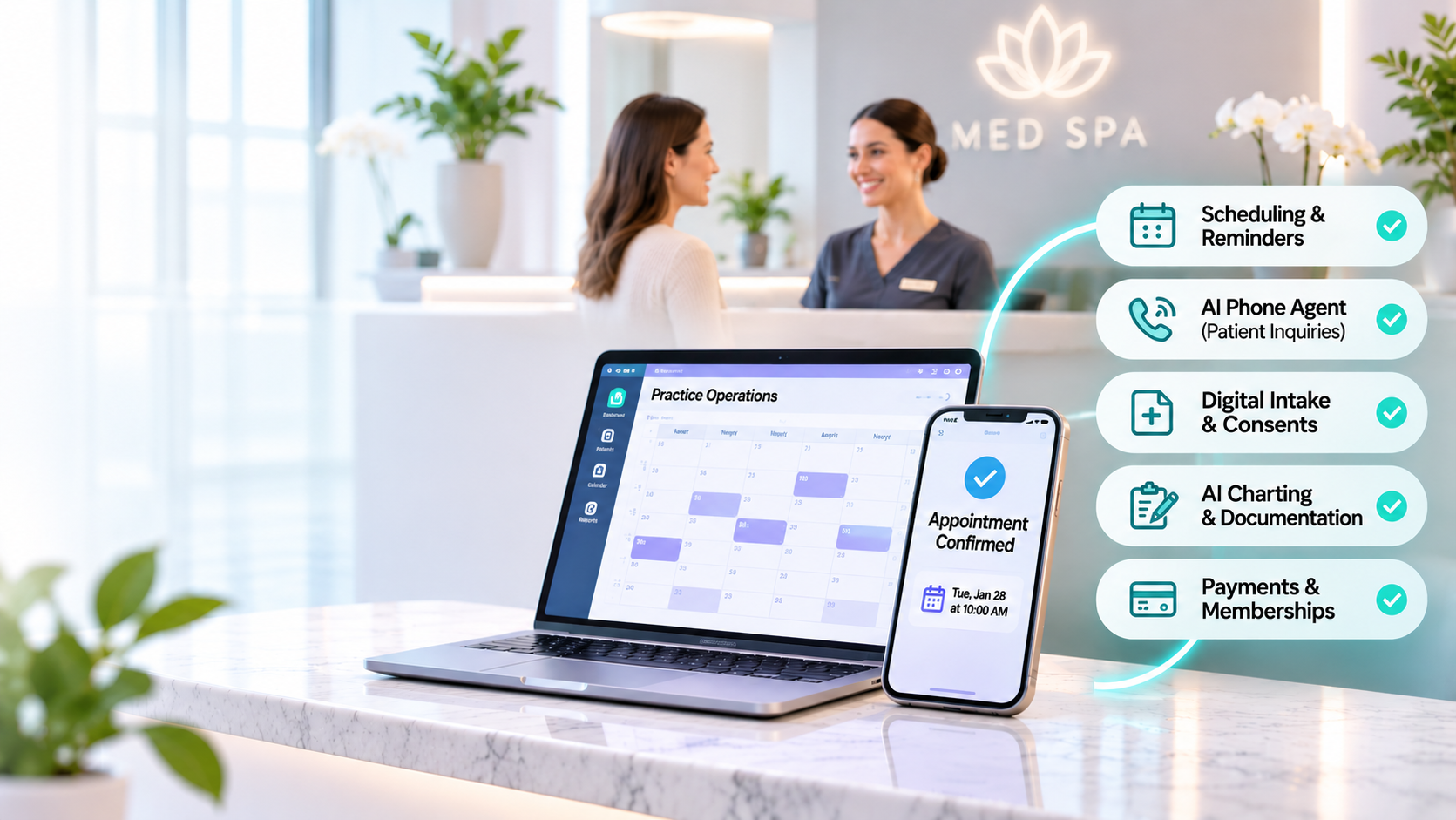
How to Automate Med Spa Operations Without Losing the Personal Touch
Running a successful medical spa involves more than delivering aesthetic treatments.
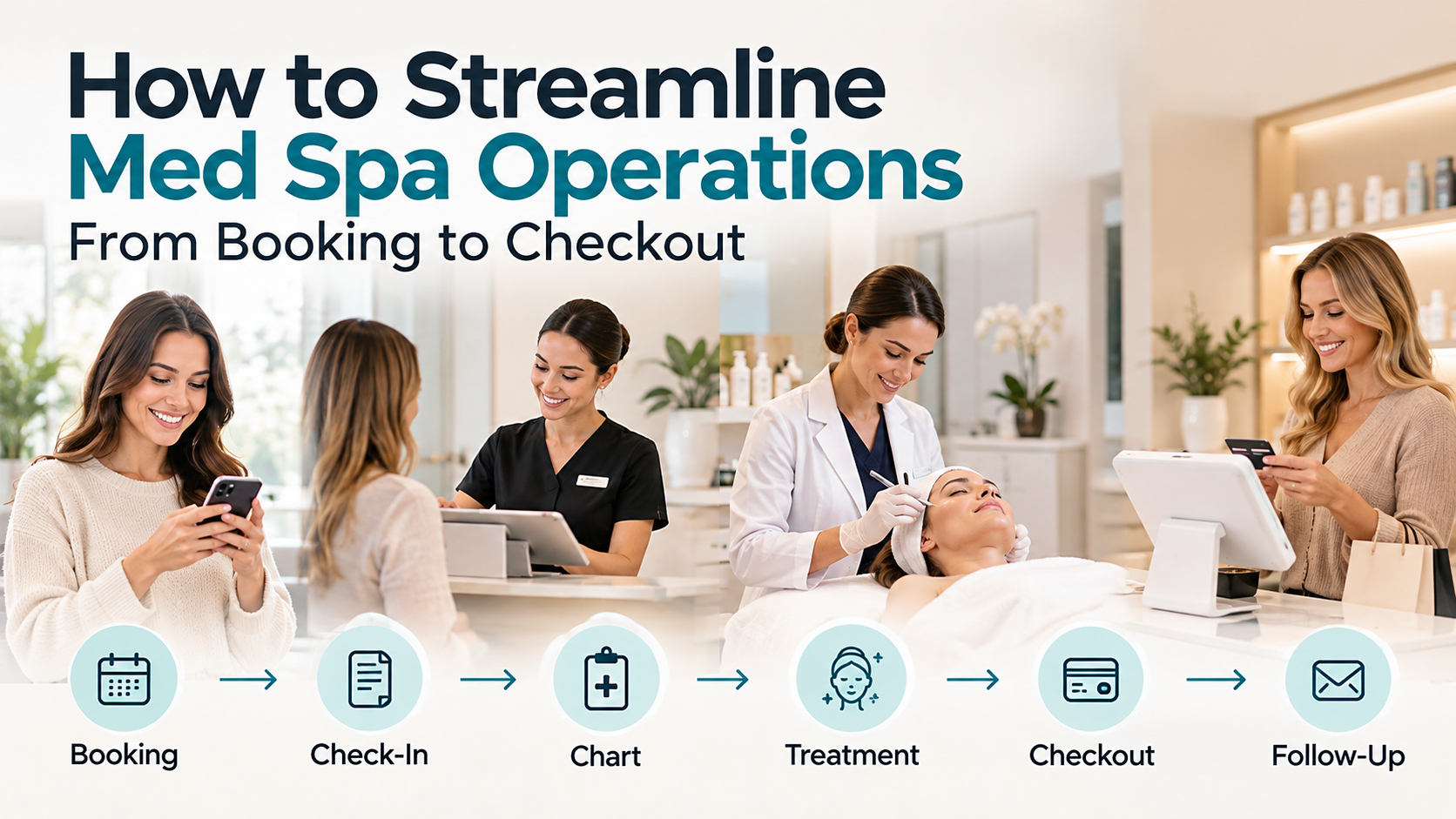
Behind every appointment, practices manage scheduling, patient inquiries, intake forms, clinical documentation, payments, and follow-up communication.
As a practice grows, these responsibilities can become increasingly difficult to manage manually.
Staff may spend considerable time answering repetitive questions, confirming appointments, updating patient information, and switching between disconnected systems.
This is where med spa automation can make a difference.
By automating repetitive administrative tasks and connecting essential workflows, medical spas can reduce unnecessary manual work while allowing their teams to focus on patient care.
However, automation should not replace personalized service.
The goal is to use technology to support staff, improve operational consistency, and create a smoother experience for patients.
What Is Med Spa Automation?
Med spa automation refers to using software and technology to manage repetitive administrative and operational tasks with less manual intervention.
These tasks may include:
- Appointment confirmations and reminders
- Patient intake and registration
- Incoming call handling
- Routine SMS responses
- Scheduling and rescheduling
- Clinical documentation assistance
- Payment requests and checkout
- Membership management
- Follow-up communication
Automation can involve predefined rules, connected software workflows, or artificial intelligence.
For example, a practice may configure its scheduling software to send appointment reminders automatically.
An AI Phone Agent may also help answer common patient questions or assist with appointment requests based on the practice's configured permissions.
The most effective approach is to automate predictable tasks while keeping staff and providers involved in decisions requiring judgment.
Why Automation Matters for Medical Spas
Medical spas often manage several workflows simultaneously.
A front-desk employee may be answering calls while checking in patients, responding to messages, processing payments, and managing the appointment calendar.
When these responsibilities rely heavily on manual processes, practices may experience:
- Delayed responses to patient inquiries
- Repetitive data entry
- Scheduling inconsistencies
- Missed communication opportunities
- Increased administrative workload
- Disconnected patient information
Automation can help organize these activities and reduce unnecessary steps.
The Agency for Healthcare Research and Quality emphasizes the importance of patient experience in healthcare, including how patients interact with healthcare services.
For medical spas, convenient communication and organized administrative processes are important parts of that experience.
1. Automate Appointment Scheduling and Reminders
Appointment scheduling is one of the most practical starting points for med spa automation.
Patients may contact a practice through its website, phone system, or messaging channels to request appointments.
When scheduling is managed manually across several systems, staff may need to repeatedly check availability and update records.
Connected scheduling software can help organize appointment information in one place.
Automation opportunities include:
- Online appointment booking
- Automated booking confirmations
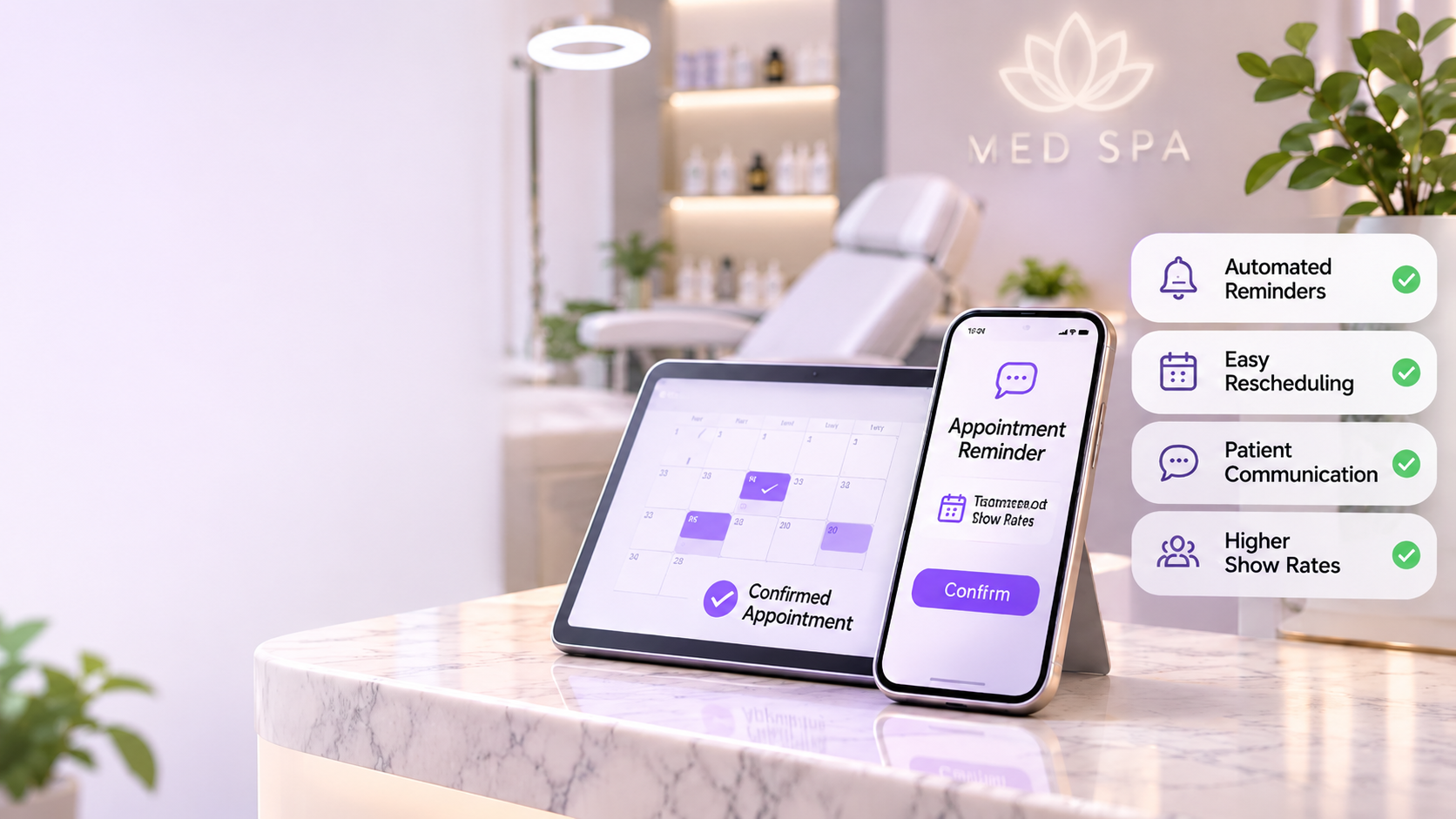
- Appointment reminders
- Cancellation notifications
- Rescheduling workflows
- Waitlist management
For example, a patient who books an appointment online may receive a confirmation message automatically.
Before the visit, the system can send a reminder containing the appointment date and time.
These workflows can help patients stay informed without requiring staff to send every message individually.
Practices should also provide convenient ways for patients to contact staff when assistance is needed.
2. Use AI to Support Incoming Patient Calls
Incoming calls are an important source of appointment requests and patient inquiries.
However, front-desk teams may not always be available to answer every call immediately.
This is particularly challenging during busy treatment hours or outside regular business hours.
An AI-powered phone agent can assist with routine communication.
Depending on its capabilities and configured permissions, an AI agent may:
- Answer incoming calls
- Respond to common questions
- Provide approved business information
- Check appointment availability
- Assist with booking and rescheduling
- Capture new patient inquiries
- Direct complex requests to staff
DigiMEDSPA's AI Phone Agent is designed to support patient communication within a connected practice-management environment.
AI should operate within clearly defined permissions and escalation rules.
Questions involving clinical advice, unusual treatment concerns, or other sensitive situations should be directed to qualified staff.
3. Simplify Patient Intake and Registration
Patient intake is another workflow that can benefit from automation.
Before an appointment, patients may need to complete medical history questionnaires, consent forms, and other required documentation.
Paper forms or disconnected digital tools can create additional work for patients and staff.
A connected intake system can help practices:
- Send digital forms
- Collect patient information
- Organize completed questionnaires
- Associate forms with patient profiles
- Identify incomplete documentation
- Reduce repetitive data entry
For example, a patient scheduled for an aesthetic consultation may receive intake forms before arriving.
Once completed, the information can be made available to authorized staff for review.
This helps the team prepare for the visit while maintaining appropriate clinical oversight.
Digital intake should not eliminate the provider's responsibility to review relevant medical information and obtain valid informed consent.
4. Connect Patient Communication Across Channels
Medical spas communicate with patients through multiple channels.
These may include phone calls, SMS, email, online booking, and patient portals.
When each channel operates independently, staff may struggle to maintain a consistent view of patient interactions.
For example, a patient may call to ask about availability and later send a text message requesting a different appointment time.
If the communication history is disconnected, staff may need to repeat questions or manually reconcile information.
DigiMEDSPA's Unified Communications solution connects business phone, SMS, chat, and eFax capabilities with broader practice workflows.
Connected communication can help teams manage inquiries while reducing unnecessary movement between separate applications.
However, practices should still establish clear policies for message review, response times, and staff escalation.
5. Use AI-Assisted Clinical Documentation
Clinical documentation is an essential responsibility for medical aesthetic providers.
During consultations and treatments, providers may need to document patient concerns, medical histories, examination findings, treatment details, and follow-up instructions.
AI-assisted documentation tools can help organize encounter information into draft clinical notes.
For example, an AI Scribe may convert recorded or dictated consultation information into a structured SOAP note.
Potential benefits include:
- Less repetitive typing
- More organized draft documentation
- Support for structured note formats
- Easier review of encounter information
- Reduced movement between documentation tools
DigiMEDSPA's AI Scribe & Charting Assistant is designed to support documentation within its EMR environment.
However, AI-generated notes must be reviewed and verified by qualified providers.
AI should not independently determine clinical findings, diagnoses, or treatment decisions.
The National Institute of Standards and Technology's AI Risk Management Framework provides guidance for organizations evaluating and managing risks associated with AI systems.
6. Streamline Checkout and Payment Workflows
Checkout is an important part of the patient experience.
After a treatment, staff may need to process payments, apply membership benefits, update patient accounts, and record product sales.
When these activities are handled through disconnected systems, additional manual steps may be required.
Connected practice-management software can help organize:
- Treatment charges
- Payment processing
- Membership benefits
- Package balances
- Retail product sales
- Patient account information
- Billing records
For example, when a patient completes a treatment, the relevant charges can be managed within the practice's checkout workflow.
Staff can then review applicable packages, membership benefits, and payment information.
Automation should support accurate transactions while preserving opportunities for staff to answer billing questions.
7. Automate Appropriate Follow-Up Communication
Patient communication should not end when an appointment is completed.
Depending on the treatment, patients may need aftercare instructions, follow-up appointments, or additional information.
Automated communication can help practices deliver appropriate information at the right stage of the patient journey.
Examples include:
- Appointment follow-up reminders
- Provider-approved aftercare instructions
- Patient satisfaction surveys
- Membership renewal notices
- Relevant rebooking reminders
Follow-up communication should be appropriate to the treatment and patient circumstances.
Practices should avoid using generic automated messages when individualized clinical guidance is necessary.
The Office of the National Coordinator for Health Information Technology explains how electronic health records can support organized information and healthcare workflows.
Connecting follow-up communication with patient records can help practices maintain better context.
8. Automate Membership and Package Management
Memberships and treatment packages are common offerings at medical spas.
However, managing recurring payments, available benefits, and package balances can become complicated as enrollment increases.
Practice-management software can help organize:
- Membership enrollment
- Recurring billing
- Package balances
- Benefit redemption
- Membership status
- Renewal information
For example, when a member checks out after a qualifying treatment, staff can review available benefits within the patient account.
This can reduce manual calculations and help maintain consistent records.
Practices should ensure membership terms, recurring billing arrangements, cancellation policies, and benefit restrictions are clearly communicated.
9. Know Which Tasks Should Remain Human-Led
Not every medical spa workflow should be automated.
Some responsibilities require professional judgment, empathy, or individualized decision-making.
These include:
- Medical consultations
- Treatment recommendations
- Clinical assessments
- Informed consent discussions
- Complication management
- Sensitive patient complaints
- Complex billing disputes
- Decisions involving patient safety
Automation should support these activities rather than replace qualified professionals.
For example, an AI agent may help schedule a consultation, but the consultation itself should be conducted by an appropriately qualified provider.
Similarly, an AI Scribe may prepare a draft note, but the provider must verify the final clinical record.
A balanced approach allows technology to handle routine tasks while staff remain responsible for personalized care.
10. Measure the Impact of Automation
Automation should be evaluated based on practical results rather than the number of automated features.
Useful operational metrics include:
| Metric | What It Helps Measure |
|---|---|
| Call Answer Rate | How consistently incoming calls are answered |
| Appointment Confirmation Rate | Percentage of appointments confirmed |
| No-Show Rate | Percentage of scheduled appointments missed |
| Average Response Time | How quickly patient inquiries receive responses |
| Intake Completion Rate | Percentage of required forms completed |
| Documentation Time | Time spent preparing and finalizing clinical notes |
| Patient Satisfaction | Feedback about communication and service |
| Staff Administrative Workload | Time spent on repetitive operational tasks |
Practices should establish baseline measurements before introducing automation.
After implementation, compare results over a consistent period.
This helps identify which workflows are improving and where additional adjustments may be needed.
How to Get Started With Med Spa Automation
Medical spas do not need to automate every process at once.
A practical approach is to begin with workflows that are repetitive, time-consuming, and relatively predictable.
Step 1: Identify repetitive tasks. Review daily operations and determine which activities require the most manual effort.
Step 2: Prioritize patient-facing workflows. Appointment reminders, intake forms, and routine communication are common starting points.
Step 3: Evaluate connected software. Consider whether existing systems can share information and support the desired workflows.
Step 4: Establish staff oversight. Define which activities can be automated and which require human review.
Step 5: Train the team. Ensure employees understand how automated processes work and when intervention is necessary.
Step 6: Monitor results. Review operational metrics, patient feedback, and workflow performance.
Automation should be introduced gradually, with clear responsibilities and ongoing evaluation.
How DigiMEDSPA Supports Connected Med Spa Automation
DigiMEDSPA provides an integrated med spa practice management platform designed to connect clinical and administrative operations.
Its ecosystem includes:
- Electronic medical records
- Appointment scheduling
- Digital intake and consent forms
- Patient management
- AI Phone and SMS Agents
- AI-assisted clinical documentation
- Unified Communications
- Billing and payments
- Membership management
- Inventory management
- Patient communication workflows
By connecting these capabilities, DigiMEDSPA helps medical aesthetic practices organize daily operations without relying on multiple disconnected tools.
Its AI features are designed to support routine communication and documentation tasks while keeping staff and providers involved in appropriate decisions.
Specific AI functionality and availability may vary by configuration and rollout.
Frequently Asked Questions
What is med spa automation?
Med spa automation involves using software and technology to manage repetitive administrative tasks, such as appointment reminders, patient intake, communication, and billing workflows.
What tasks can a medical spa automate?
Common examples include appointment confirmations, reminders, digital intake, routine patient inquiries, membership billing, and certain follow-up communications.
Can AI answer calls for a medical spa?
Yes. AI phone agents can assist with incoming calls, routine questions, and appointment-related requests, depending on the platform and configured permissions.
Can AI replace med spa front-desk staff?
AI can support repetitive administrative tasks, but staff remain important for complex inquiries, patient relationships, clinical coordination, and situations requiring human judgment.
Is med spa automation HIPAA compliant?
Automation is not automatically HIPAA compliant. Practices subject to HIPAA must evaluate vendors, data handling, access controls, business associate agreements where required, and other applicable safeguards.
The HHS HIPAA Security Rule provides guidance on protecting electronic protected health information.
How can a med spa start automating operations?
Start by identifying repetitive workflows, evaluating connected software, defining staff responsibilities, and measuring operational performance after implementation.
Simplify Med Spa Operations With DigiMEDSPA
Managing a medical spa requires coordination across scheduling, patient communication, clinical documentation, billing, and daily administrative tasks.
DigiMEDSPA brings these workflows together through connected practice-management software, native AI capabilities, and unified communications.
Instead of managing multiple disconnected systems, practices can use one integrated environment to support daily operations and patient care.
Explore DigiMEDSPA's All-in-One Med Spa Software →
DigiMEDSPA. One Platform. Every Solution.