How AI Scribes Help Med Spa Providers Save Time on Clinical Documentation
Clinical documentation is an essential part of medical spa operations.
Providers must record patient histories, consultation details, treatment information, clinical observations, and follow-up plans.
Although accurate documentation is important for patient care and practice operations, completing clinical notes can require considerable time.
This is where AI scribes for med spas are becoming increasingly relevant.
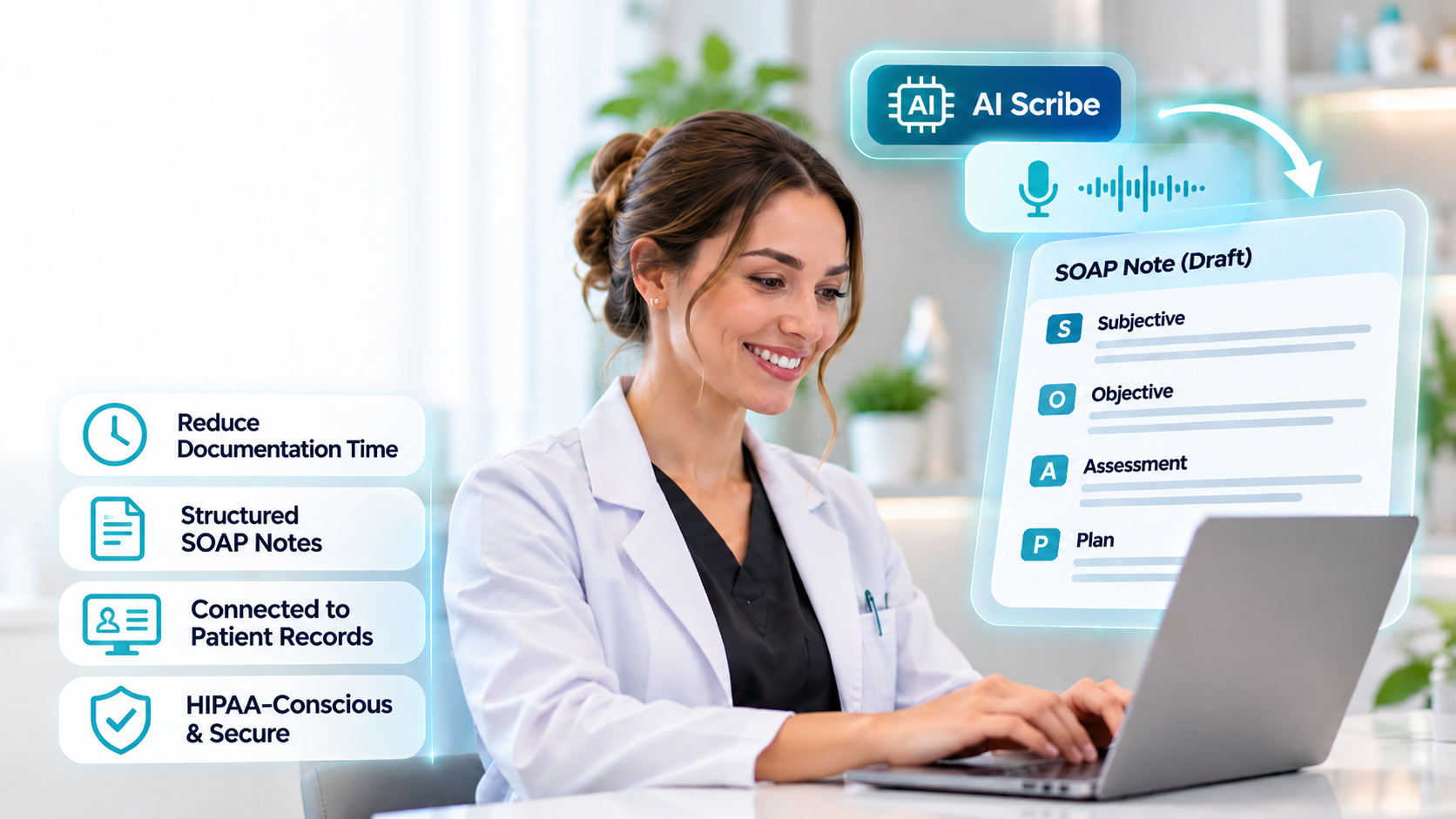
AI-powered documentation tools can help providers create draft notes, organize encounter information, and reduce repetitive typing while keeping clinical review and approval in the hands of qualified professionals.
What Is an AI Scribe for Medical Spas?
An AI scribe is a software tool that uses artificial intelligence to assist with clinical documentation.
Depending on the platform, it may process recorded conversations or dictated information and organize the content into structured clinical notes.
For example, a provider conducting an aesthetic consultation may discuss the patient's concerns, medical history, treatment goals, and recommended next steps.
An AI scribe can help convert relevant information from that encounter into a draft clinical note.
The provider then reviews the documentation, corrects any errors, and approves the final record.
AI-generated notes should never be treated as automatically accurate or complete.
1. Reduce Repetitive Documentation Tasks
Providers may spend time entering similar information across multiple sections of a patient chart.
An AI scribe can assist by organizing relevant encounter details into predefined documentation formats.
This may reduce repetitive typing and allow providers to focus more attention on the consultation.
However, the time saved depends on the tool's accuracy, configuration, and the amount of review required.
A useful AI scribe should make documentation easier to manage without introducing additional administrative complexity.
2. Support Structured SOAP Notes
SOAP notes are commonly used to organize clinical information.
The format includes:
- Subjective: Information reported by the patient
- Objective: Relevant observations and examination findings
- Assessment: The provider's clinical assessment
- Plan: Recommended treatment, instructions, and follow-up
An AI scribe may help organize encounter information into these sections.
For example, a consultation involving dermal fillers may include the patient's aesthetic concerns, relevant medical history, examination findings, proposed treatment areas, and follow-up instructions.
The provider must verify that the note accurately reflects the encounter.
The Office of the National Coordinator for Health Information Technology explains how electronic health records can support organized clinical information and healthcare workflows.
3. Keep Documentation Connected to Patient Records
AI documentation becomes more useful when it connects with the existing EMR.
A standalone transcription tool may generate text that staff must manually copy into the patient record.
An integrated AI scribe may allow providers to review documentation within the same environment used for patient histories, treatment records, and clinical notes.
This can reduce unnecessary movement between applications.
Practices should confirm exactly which chart fields an AI scribe can access or update.
4. Support Different Aesthetic Treatment Workflows
Medical spas provide a variety of services, each with different documentation requirements.
Examples include:
- Injectables consultations
- Laser treatment visits
- Skin consultations
- Microneedling procedures
- Wellness consultations
- Follow-up appointments
An AI scribe should be flexible enough to support different encounter types without assuming every visit follows the same clinical structure.
Providers should be able to customize documentation and make corrections where necessary.
5. Maintain Provider Review and Clinical Oversight
AI can assist with documentation, but it cannot replace the responsibility of the treating provider.
AI-generated notes may omit information, misinterpret speech, or introduce details that were not discussed.
Practices should establish a review process covering:
- Clinical accuracy
- Completeness
- Patient identity
- Medication information
- Treatment details
- Follow-up instructions
- Provider approval
Documentation should be finalized only after appropriate professional review.
6. Protect Patient Privacy
Clinical recordings and documentation may contain sensitive patient information.
Before using an AI scribe, practices should evaluate how information is collected, processed, stored, and accessed.
Important considerations include recording consent, access permissions, retention policies, vendor agreements, and applicable privacy laws.
For HIPAA-regulated practices, the HHS HIPAA Security Rule provides a framework for protecting electronic protected health information.
An AI tool should be evaluated as part of the practice's overall compliance program.
7. Evaluate AI Scribe Software Before Implementation
Not every AI documentation solution offers the same capabilities.
Before selecting a platform, consider:
- Does it integrate with the existing EMR?
- Can providers customize note templates?
- Does it support different encounter types?
- Can providers edit generated notes?
- How are recordings handled?
- Does it require explicit patient consent?
- Are there usage limits or additional charges?
- What happens if the transcription is inaccurate?
A demonstration using realistic aesthetic consultation scenarios can help practices evaluate usability.
How DigiMEDSPA Approaches AI-Assisted Charting
DigiMEDSPA's AI Scribe & Charting Assistant is designed to support documentation within its connected med spa EMR.
Depending on configuration, providers can use the tool to generate draft notes, encounter summaries, and structured chart information.
Providers remain responsible for reviewing, editing, and verifying the generated content.
Because the AI tools connect with the broader practice-management environment, the goal is to support documentation without requiring a separate workflow.
Availability and functionality should be confirmed during a demonstration.
Frequently Asked Questions
Can an AI scribe create SOAP notes?
Yes. Some AI scribes can organize encounter information into SOAP note sections. Providers must review and approve the generated documentation.
Can AI scribes document aesthetic treatments?
Some AI scribes support aesthetic consultations and procedure-related notes. The specific capabilities depend on the platform and configuration.
Does an AI scribe replace clinical documentation review?
No. Qualified providers remain responsible for verifying clinical accuracy and completeness.
Is an AI scribe the same as transcription software?
Not exactly. Transcription software primarily converts speech into text, while AI scribes may also organize information into structured clinical documentation.
Explore DigiMEDSPA AI Scribe & Charting
Clinical documentation should support patient care without creating unnecessary administrative work.
DigiMEDSPA combines EMR functionality with AI-assisted charting tools designed for medical aesthetic practices.
Explore DigiMEDSPA's AI Solutions →
Smarter Documentation. Connected Clinical Workflows.