How AI Is Changing Med Spa Front Desk Operations
The front desk plays an essential role in the daily operations of a medical spa. From answering calls and scheduling appointments to responding to patient inquiries and coordinating with providers, front-desk teams manage multiple responsibilities throughout the day.
As practices grow, handling these activities consistently can become more challenging. Calls may arrive while staff are assisting patients, managing check-in, or processing payments.
This is where AI front desk technology for med spas is beginning to play a more significant role.
AI-powered reception tools can support routine inquiries, appointment-related conversations, lead capture, and communication workflows, helping practices manage administrative activity while keeping staff involved when human assistance is needed.
What Is an AI Front Desk for Med Spas?
An AI front desk is a technology solution designed to assist with selected receptionist and administrative tasks using artificial intelligence.
Depending on the platform, an AI front desk may be able to:
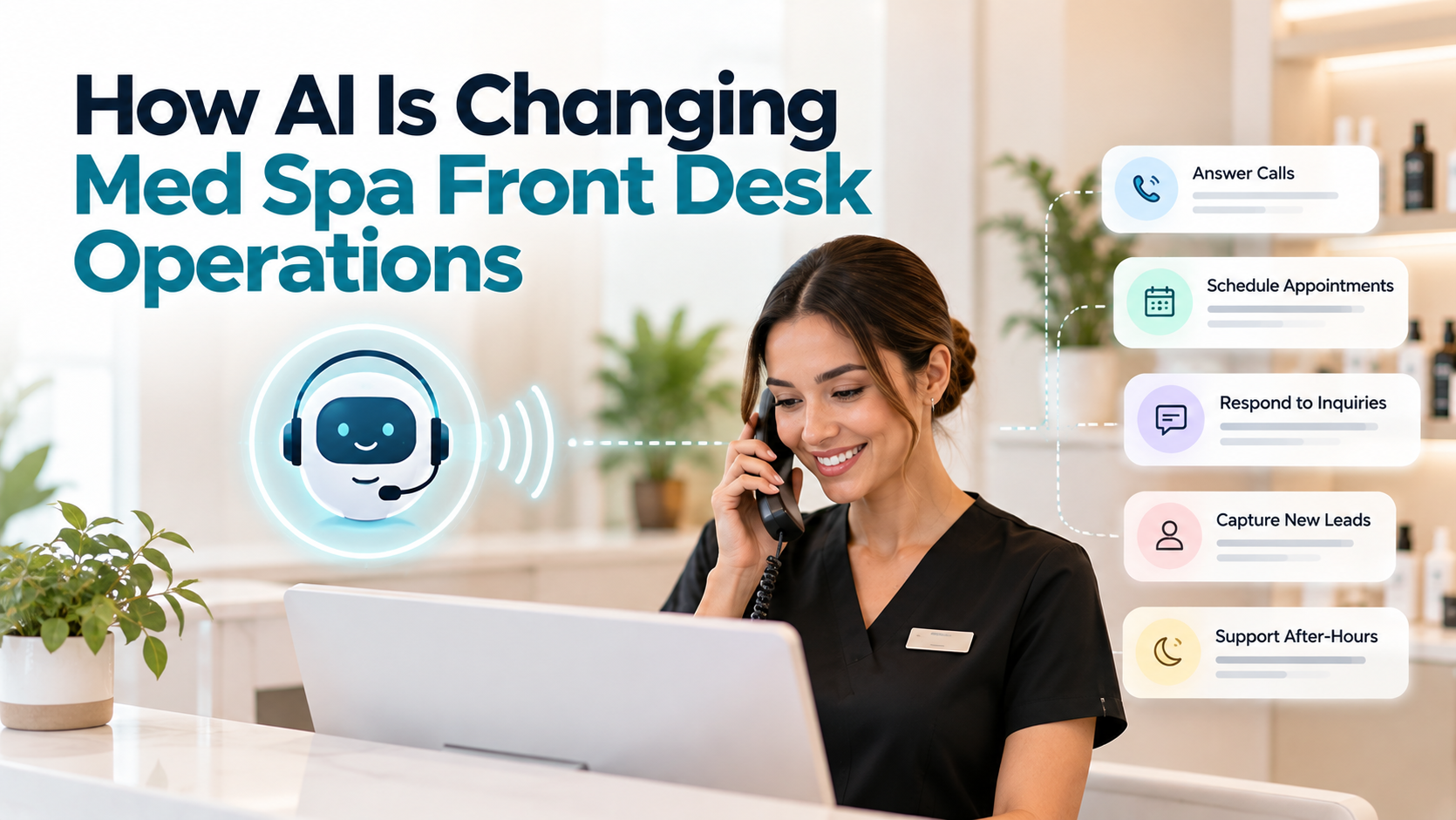
- Answer incoming phone calls
- Identify the reason for an inquiry
- Respond to approved frequently asked questions
- Provide general practice information
- Check appointment availability
- Assist with appointment booking
- Capture contact information
- Route conversations to staff
- Support after-hours inquiries
Unlike a basic automated phone menu, conversational AI can interpret natural-language requests and respond according to configured workflows.
However, capabilities vary by provider. Some tools primarily answer questions or collect messages, while others integrate directly with scheduling and patient-management systems.
Why Front Desk Efficiency Matters
Front-desk operations affect both the patient experience and the practice's daily workflow.
A receptionist may need to answer a phone call while another patient is checking in, a provider requests information, and someone else is ready to complete checkout.
When multiple tasks compete for attention, communication delays can occur.
For example, a prospective patient may call to ask about microneedling appointments while staff are occupied with an existing patient.
If the call goes unanswered, the practice may need to follow up later, and the prospective patient may contact another provider in the meantime.
AI-assisted reception can provide another way to handle routine inquiries during busy periods.
The objective is not to eliminate human interaction. It is to help staff manage repetitive communication more consistently.
1. Supporting Incoming Calls
Phone calls remain an important communication channel for many medical spas.
Patients may call to ask about services, business hours, appointments, preparation instructions, or existing bookings.
An AI receptionist can be configured to respond to approved questions and identify the caller's intent.
For example, a caller might ask:
"Do you offer microneedling consultations?"
The AI may provide approved service information and guide the caller toward the appropriate appointment workflow.
Questions requiring clinical judgment, urgent attention, or personalized medical advice should be routed to qualified staff rather than answered independently by an AI receptionist.
2. Assisting With Appointment Scheduling
Scheduling is one of the most practical applications of AI in med spa operations.
When connected to a practice's booking system, an AI front desk may be able to review available appointment types, check provider availability, and assist with booking or rescheduling.
This connection is important.
An AI tool that cannot access the practice's scheduling system may only be able to collect information for staff to process later.
A connected system can support a more complete workflow:
Patient Inquiry → Appointment Availability → Booking → Confirmation
Practices should confirm exactly which scheduling actions their AI solution can perform and when staff approval is required.
3. Capturing New Patient Inquiries
Not every prospective patient is ready to book immediately.
Some may have questions about services, consultation requirements, appointment availability, or the next steps.
An AI front desk can help collect relevant contact information and the reason for the inquiry.
Depending on the system, that information may be added to a lead-management workflow for staff follow-up.
For med spas, this can be particularly useful when inquiries arrive outside regular business hours.
However, practices should ensure that information collection is limited to what is appropriate and that privacy requirements are addressed.
The U.S. Department of Health and Human Services provides guidance on the HIPAA Privacy Rule and the protection of health information.
4. Supporting After-Hours Communication
Patients do not always contact a med spa during business hours.
They may browse treatment options in the evening or call after work to ask about availability.
AI-powered reception can provide a way to respond to certain inquiries outside normal operating hours.
For example, it may communicate approved business information, collect appointment requests, or assist with scheduling when supported by the system.
Practices should establish clear rules for situations requiring immediate human attention, including urgent medical concerns.
AI reception should not be presented as emergency medical support.
5. Keeping Communication Connected
One of the most important considerations is whether AI operates as a standalone tool or connects with the practice's existing technology.
An independent AI answering service may collect calls and messages but require staff to manually transfer information into scheduling or patient-management software.
A connected AI solution may be able to work within existing communication and appointment workflows.
This can help reduce unnecessary duplication and provide better context when staff take over an interaction.
DigiMEDSPA's Unified Communications solution connects phone, SMS, chat, and other communication tools within its broader practice-management ecosystem.
6. Where Human Staff Remain Essential
AI should support front-desk staff rather than replace professional judgment.
Human involvement remains important for sensitive conversations, complex scheduling situations, complaints, clinical questions, and decisions requiring individualized assessment.
Practices should define:
- Which inquiries AI can handle
- Which information AI may access
- When calls should be transferred
- How staff review AI activity
- How patient information is protected
- What happens when AI cannot complete a request
Clear operating rules help make AI more predictable and useful.
The World Health Organization's guidance on AI ethics and governance discusses the importance of accountability, safety, and human oversight when AI is used in healthcare.
7. How to Evaluate AI Front Desk Software
Before selecting an AI receptionist, request a demonstration using realistic patient scenarios.
Ask whether the system can access live appointment availability, work with existing phone services, recognize common patient requests, capture leads, and escalate conversations appropriately.
Also review its privacy and security controls, implementation requirements, pricing, and reporting.
An AI tool should be evaluated based on the tasks it can reliably complete—not simply the number of features advertised.
The National Institute of Standards and Technology (NIST) AI Risk Management Framework offers additional guidance for organizations evaluating and managing AI-related risks.
How DigiMEDSPA Approaches AI Front Desk Operations
DigiMEDSPA's AI Front Desk is designed to work within its connected med spa technology ecosystem.
Its intended capabilities include answering incoming calls, identifying caller intent, responding to approved questions, checking scheduling availability, assisting with appointment workflows, capturing leads, and routing conversations to staff.
DigiMEDSPA also connects practice management, EMR, phone, SMS, and patient workflows within the broader platform.
This approach is designed to make AI part of the practice's existing workflow rather than another isolated application.
Individual AI capabilities may be released in phases, so practices should confirm current availability during a demonstration.
Frequently Asked Questions
Can an AI receptionist book med spa appointments?
Some AI receptionists can assist with booking when integrated with a compatible scheduling system. Other tools only collect appointment requests for staff follow-up.
Can AI answer med spa calls after business hours?
Yes. Certain AI reception systems can handle approved inquiries outside business hours, depending on their configuration.
Does an AI front desk replace a receptionist?
Not necessarily. AI is generally most useful for supporting routine administrative tasks while staff manage complex interactions and situations requiring human judgment.
Is AI front desk software appropriate for medical practices?
It can be, provided the implementation meets applicable privacy, security, operational, and clinical requirements. Practices should evaluate each vendor's safeguards and workflows.
Explore AI-Powered Med Spa Operations
Front-desk technology is evolving beyond traditional call answering.
With the right integrations and operating controls, AI can become part of a more connected scheduling, communication, and patient-management workflow.
Discover DigiMEDSPA AI Front Desk →
One Platform. One Workflow. One Connected Practice.