Why Website Accessibility Matters for Medical Spas
A medical spa website is often the first place prospective patients interact with a practice.
Visitors may use the website to explore treatments, review provider information, find contact details, or request appointments.
However, not every visitor interacts with a website in the same way.
Some people use screen readers, keyboard navigation, magnification tools, or other assistive technologies to access digital content.
For medical spas, website accessibility is an important part of creating a more inclusive and usable online experience.
What Is Website Accessibility?
Website accessibility means designing and maintaining digital content so people with different abilities can access and use it.
An accessible website should support visitors who may have visual, hearing, motor, or cognitive disabilities.
For example, a visitor who cannot use a mouse should still be able to navigate the website using a keyboard.
Someone using a screen reader should be able to understand the purpose of links, buttons, forms, and images.
The U.S. Department of Justice's ADA website accessibility guidance explains why accessible websites matter for businesses open to the public.
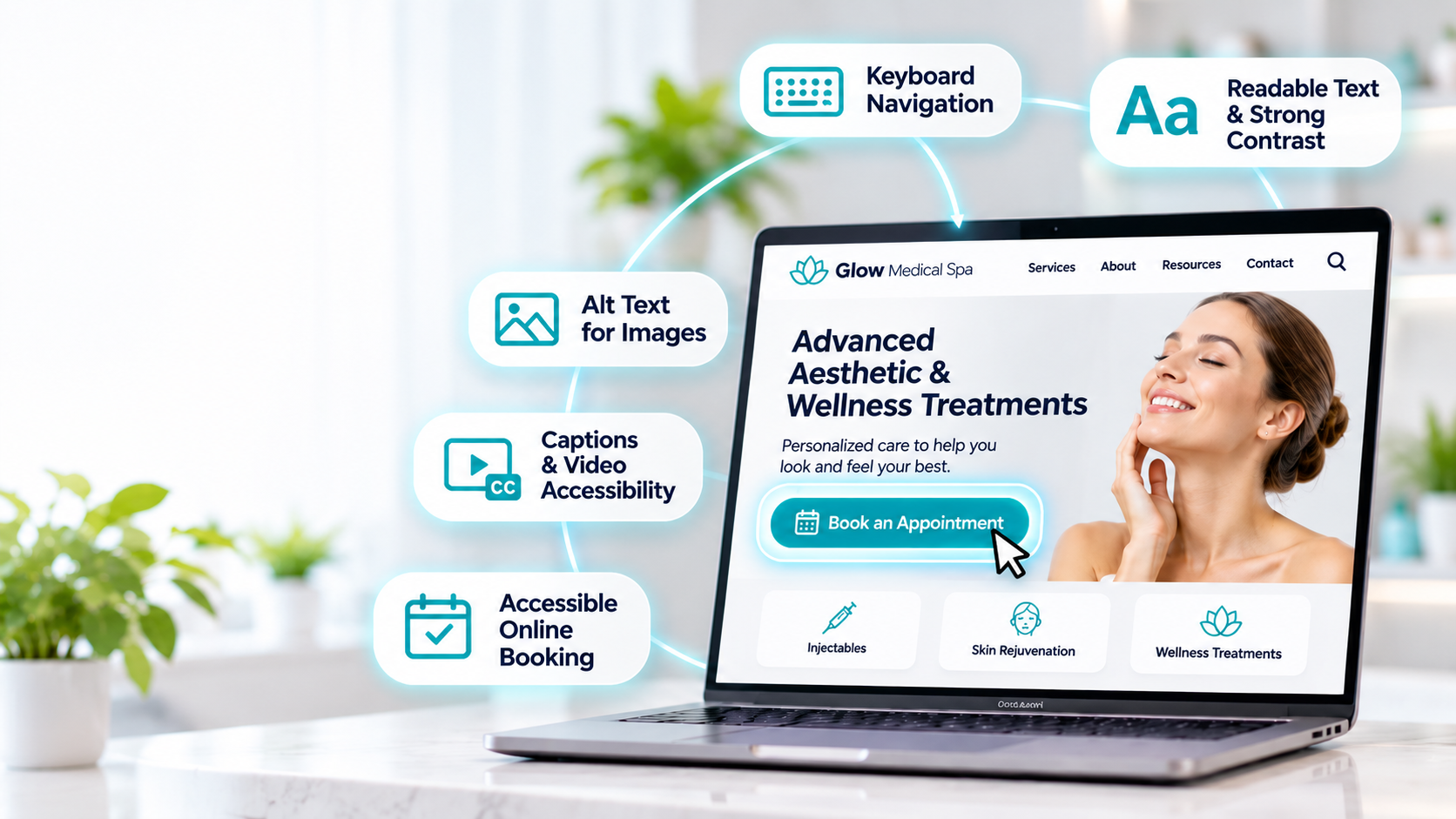
1. Make Website Navigation Easier
Clear navigation helps visitors find the information they need.
Medical spa websites often contain treatment categories, provider biographies, pricing information, booking links, and contact pages.
These sections should be organized logically.
Good practices include:
- Clear navigation labels
- Descriptive page headings
- Consistent menus
- Keyboard-accessible links
- Visible keyboard focus indicators
- Logical page structure
Accessible navigation can benefit visitors using assistive technologies as well as people browsing on mobile devices.
2. Use Readable Text and Appropriate Contrast
Text should be easy to read against its background.
Low-contrast combinations, such as light gray text on a white background, may be difficult for some visitors to see.
Websites should also allow users to enlarge text without losing essential information or functionality.
The Web Content Accessibility Guidelines (WCAG) provide technical recommendations for making web content more accessible.
Practices should consider contrast, text resizing, spacing, and responsive layouts during website design.
3. Make Online Booking Accessible
Online booking is an important feature for many medical spas.
However, a booking system may create barriers if it cannot be navigated without a mouse or if its form fields are not properly labeled.
An accessible booking experience should include:
- Clearly labeled input fields
- Understandable instructions
- Accessible date and time selection
- Keyboard navigation
- Clear error messages
- Accessible confirmation steps
Practices should test the complete booking process rather than checking only the homepage.
4. Provide Alternative Text for Images
Medical spa websites frequently use treatment photography, provider portraits, and informational graphics.
Images that communicate meaningful information should include descriptive alternative text.
For example, a provider photograph may use alternative text identifying the provider and their professional role.
Decorative images generally do not need descriptive alternative text.
Before-and-after images require thoughtful descriptions that explain their purpose without making unsupported treatment claims.
5. Make Videos More Accessible
Medical spas may use videos to introduce providers, explain services, or demonstrate technology.
Videos containing spoken information should include accurate captions.
Captions help people who are deaf or hard of hearing and may also benefit visitors watching without sound.
Important visual information may require additional description.
Practices should also ensure video controls are accessible.
6. Review Forms and Contact Pages
Contact forms and consultation request forms should be easy to understand and complete.
Visitors should know which fields are required and how to correct errors.
For example, if a phone number is entered incorrectly, the form should provide a clear explanation rather than relying only on a red border.
Accessible forms are particularly important when they are the primary way visitors request appointments.
7. Understand ADA and WCAG Considerations
The Americans with Disabilities Act applies to many businesses open to the public, including medical offices and other service providers.
The Department of Justice has explained that inaccessible websites can prevent people with disabilities from accessing services offered by public accommodations.
WCAG provides technical accessibility standards commonly used to guide website development.
However, businesses should not assume that installing a single accessibility widget automatically makes a website fully accessible or legally compliant.
Accessibility requires attention to design, content, functionality, testing, and ongoing maintenance.
Practices should seek qualified legal guidance when determining their specific obligations.
8. Maintain Accessibility Over Time
Website accessibility is not a one-time project.
New treatment pages, images, videos, booking tools, and design updates may introduce accessibility barriers.
Practices should regularly review:
- Navigation
- Forms
- Image descriptions
- Video captions
- Color contrast
- Mobile usability
- Keyboard access
- Third-party booking integrations
Automated testing tools can help identify certain issues, but manual testing remains important.
How DigiMEDSPA Supports Accessible Website Design
DigiMEDSPA provides custom website design and accessibility-focused solutions for medical aesthetic practices.
Its website services include responsive design, content management, booking integration, and accessibility-related functionality.
These services connect with DigiMEDSPA's broader practice-management and patient communication ecosystem.
An accessible website should help visitors find information, explore services, and contact the practice with fewer barriers.
Frequently Asked Questions
Do medical spa websites need to be accessible?
Many medical spas are businesses open to the public and may have obligations under the ADA. Specific legal requirements depend on the circumstances and applicable law.
What is WCAG?
WCAG stands for Web Content Accessibility Guidelines. It provides technical recommendations for making digital content more accessible.
Does an accessibility widget guarantee ADA compliance?
No. Accessibility widgets may assist with certain functions, but they do not replace accessible development, testing, and ongoing maintenance.
Does website accessibility matter for online booking?
Yes. Booking forms, calendars, buttons, and confirmation processes should be usable by people relying on assistive technologies.
Build a More Accessible Med Spa Website
Your medical spa website should make it easier for visitors to learn about services, connect with your team, and request appointments.
DigiMEDSPA provides website solutions designed for medical aesthetic practices, with accessibility-focused functionality and connected booking options.
Explore DigiMEDSPA Website Solutions →
Better Accessibility. Better Digital Experiences.