
How to Improve the Med Spa Patient Journey From First Contact to Follow-Up
A patient's experience with a med spa begins before they enter the practice.
It can start with a website visit, phone call, online search, SMS conversation, social media interaction, or appointment request.
From there, every interaction contributes to the overall patient journey.
For med spas, improving that journey means looking beyond the treatment itself and considering how easily patients can communicate, book, provide information, navigate their appointment, and stay connected afterward.
1. Understand the Complete Patient Journey
Start by mapping the stages a typical patient experiences:
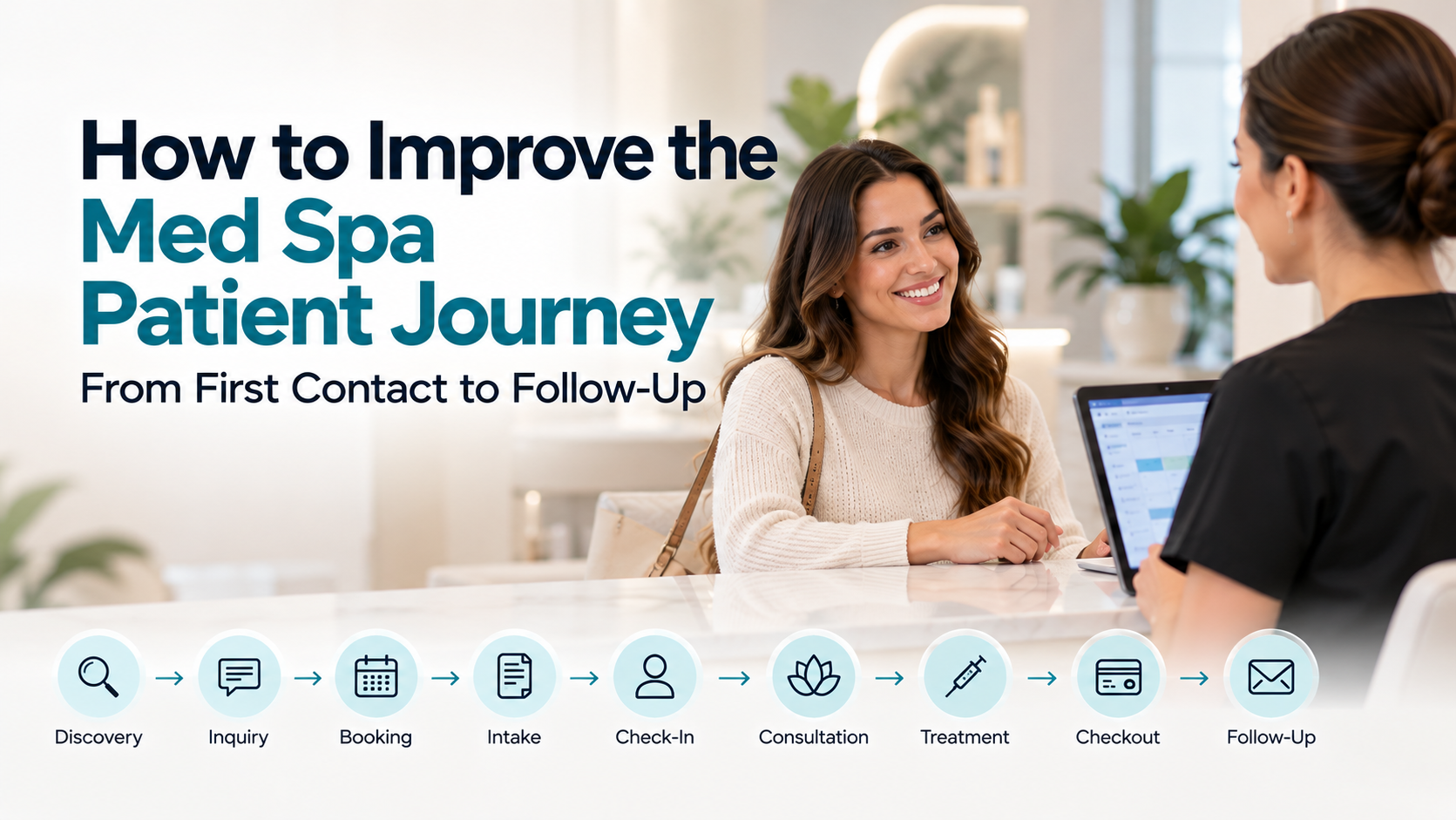
Discovery → Inquiry → Booking → Intake → Check-In → Consultation → Treatment → Checkout → Follow-Up
Each stage presents an opportunity to make the experience clearer and more consistent.
For example, a practice may deliver an excellent treatment experience but still create frustration if appointment scheduling is difficult or communication is inconsistent.
Patient experience should therefore be considered across the entire journey.
The Agency for Healthcare Research and Quality (AHRQ) explains that patient experience encompasses the range of interactions patients have with the healthcare system, including communication with providers and staff.
2. Make It Easy to Contact the Practice
Patients have different communication preferences.
Some may call. Others may prefer SMS or an online form.
Practices should make it clear how prospective patients can:
- Ask a question
- Request an appointment
- Book online
- Contact the front desk
- Reschedule
- Cancel when necessary
The easier these options are to find and use, the less friction exists at the beginning of the relationship.
An integrated unified communications system can help practices manage phone calls, SMS, and other patient interactions within connected workflows.
3. Simplify Appointment Booking
Booking is often one of the patient's first direct experiences with the practice.
A complicated process can create unnecessary friction before the appointment even begins.
Online booking can complement traditional front-desk scheduling by allowing patients to initiate the process digitally.
Regardless of how the appointment is created, patients should receive clear information about the appointment and any next steps.
The Office of the National Coordinator for Health Information Technology provides resources on how digital health technology can support patient access, engagement, and healthcare workflows.
4. Improve Pre-Appointment Communication
Patients may need information before arriving.
This could include appointment confirmation, forms, instructions, or reminders depending on the practice and service.
A structured communication process helps ensure patients receive relevant information at the appropriate point in their journey.
It can also reduce the amount of routine information staff must communicate manually.
Practices exploring automation may also consider an AI Front Desk to support routine inquiries and appointment-related communication, depending on available capabilities.
5. Create a Smoother Intake Experience
Patient intake is necessary, but it doesn't have to feel unnecessarily complicated.
Digital questionnaires and forms can help patients provide information before or during their visit.
When that information connects with the patient profile, staff and providers can access it more efficiently.
Patients are also less likely to be asked for the same information repeatedly across different stages.
The U.S. Department of Health and Human Services provides guidance on protecting health information, an important consideration when collecting and managing patient intake data.
6. Give Providers Better Context
Technology affects patient experience behind the scenes as well.
When providers can easily review relevant patient information, previous visits, notes, treatment history, photographs, and other documentation, they have more context available for the encounter.
A connected patient profile can help reduce fragmented information across multiple systems.
Using a connected med spa EMR and practice management platform can help bring clinical documentation and administrative workflows into the same environment.
7. Make Checkout Part of the Experience
Checkout is one of the final in-person interactions during a visit.
The process should clearly account for applicable services, products, memberships, promotions, and payment options.
An organized checkout workflow can make the end of the visit feel like a continuation of the same experience rather than an unrelated administrative process.
8. Stay Connected After the Visit
Patient engagement can continue after checkout.
Depending on the practice and treatment, follow-up may include:
- Appropriate post-visit communication
- Surveys
- Appointment reminders
- Review requests
- Future booking communication
- Membership information
The objective isn't to send more messages.
It is to send relevant communication at appropriate points in the patient relationship.
The AHRQ CAHPS program provides resources for understanding and measuring patient experience, including communication and care-related interactions.
9. Use Technology Without Losing the Human Experience
Automation and AI can support several stages of the patient journey.
For example, technology may assist with routine inquiries, appointment workflows, reminders, SMS interactions, or administrative follow-up.
But automation should support staff rather than make the experience feel impersonal.
Practices should determine when technology can handle a routine interaction and when a patient should be connected with a staff member.
The World Health Organization's guidance on AI for health emphasizes ethical considerations, accountability, and human oversight in healthcare AI.
Creating a Connected Patient Journey With DigiMEDSPA
DigiMEDSPA connects key patient-facing and practice workflows within one platform.
From appointment scheduling and patient profiles to communication, clinical workflows, checkout, and follow-up, practices can manage multiple stages of the patient journey within a connected ecosystem.
The objective is simple:
Make it easier for patients to move through the practice while giving staff the information and tools they need to support them.
A better patient journey isn't created by one feature. It comes from making each interaction feel like part of the same experience.


