
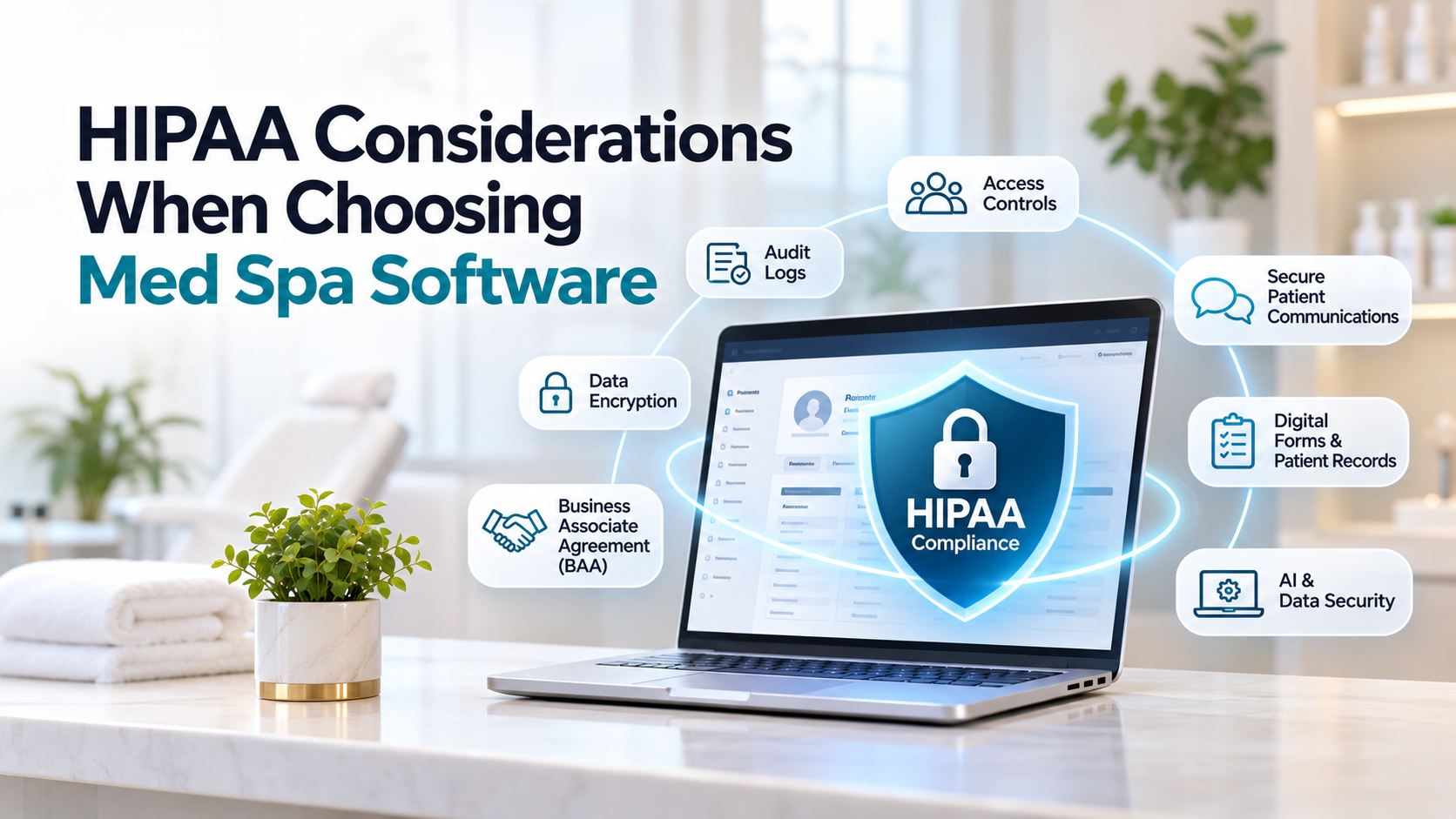
HIPAA Considerations When Choosing Med Spa Software
Medical spas often manage sensitive patient information alongside appointment scheduling, billing, communications, and other administrative activities.
Depending on their operations and legal status, med spas may be subject to the Health Insurance Portability and Accountability Act (HIPAA), which establishes federal requirements for protecting certain health information.
For practices evaluating new technology, understanding the relationship between software and HIPAA compliance is essential.
However, selecting software marketed as "HIPAA-compliant" does not automatically make a medical spa compliant.
Compliance also depends on how the practice configures and uses the technology, manages access, trains staff, establishes policies, and works with vendors.
What Does HIPAA Mean for Med Spa Software?
HIPAA establishes privacy and security requirements for protected health information, commonly called PHI, when handled by covered entities and their business associates.
Whether a particular med spa is a HIPAA covered entity depends on its activities and whether it meets the applicable legal definitions, including certain electronic healthcare transactions.
Some medical spas may also be subject to state privacy, medical-record, or consumer-data laws regardless of HIPAA status.
For practices subject to HIPAA, software selection should account for how electronic protected health information, or ePHI, is created, stored, accessed, transmitted, and maintained.
1. Understand Your Practice's Compliance Obligations
Before evaluating vendors, determine which legal and regulatory requirements apply to your practice.
Not every medical spa has the same structure.
A practice may provide medical services, wellness services, cosmetic services, or a combination of these.
Its regulatory obligations may depend on provider relationships, business operations, billing practices, and applicable state laws.
Practice owners should consult qualified legal or compliance professionals when determining their obligations.
This helps ensure software requirements are based on the practice's actual responsibilities rather than assumptions.
2. Evaluate Access Controls
Access control is a central consideration for protecting patient information.
Not every employee needs access to every type of record.
For example, front-desk staff may require appointment and contact information, while providers may need access to clinical histories and treatment documentation.
Software should support appropriate user permissions and administrative controls.
When evaluating a platform, ask:
- Can access be assigned by role?
- Can administrators restrict sensitive functions?
- Can user accounts be disabled promptly?
- How is user authentication handled?
- Can access be reviewed regularly?
The objective is to support authorized access while reducing unnecessary exposure of patient information.
3. Review Audit Logging
Audit controls help organizations examine activity involving electronic protected health information.
Depending on the system, logs may record user access, changes, and other relevant actions.
Ask software vendors what events are logged, how records can be reviewed, how long logs are retained, and whether administrators can investigate unusual activity.
Audit functionality is one part of a broader security program and should be evaluated alongside practice policies and monitoring procedures.
4. Understand Encryption and Data Protection
Encryption is an important safeguard for sensitive information.
Practices should ask vendors how data is protected during transmission and while stored.
HIPAA's Security Rule includes encryption-related implementation specifications that require appropriate assessment rather than treating every possible encryption measure as an identical universal mandate.
A proper security review should consider the vendor's technical controls, the practice's risk analysis, and any applicable legal requirements.
Ask vendors to explain their approach to secure transmission, storage, backups, authentication, and incident response.
5. Confirm Business Associate Agreements
When a software provider creates, receives, maintains, or transmits PHI on behalf of a HIPAA covered entity, it may be acting as a business associate.
In applicable circumstances, a Business Associate Agreement (BAA) is required.
A BAA establishes contractual obligations concerning permitted uses and disclosures of PHI and other responsibilities.
Practices should verify whether the vendor will sign an appropriate BAA and understand which services are covered.
A vendor's marketing claim that its software is "HIPAA-ready" should not replace this review.
6. Evaluate Patient Communications
Medical spas communicate with patients through phone calls, SMS, email, forms, and online booking systems.
These communications may involve sensitive information.
Practices should examine how each communication channel handles patient data and whether appropriate safeguards are in place.
For example, ordinary text messaging may introduce privacy and security considerations depending on the information shared, the technologies involved, and the practice's policies.
Evaluate how communications connect with patient records, who can access them, and whether third-party services are involved.
7. Consider Digital Forms and Patient Records
Digital questionnaires, consent forms, treatment photographs, and clinical notes are important parts of many aesthetic workflows.
When selecting software, determine how these records are stored and associated with patients.
Also examine access permissions, record retention, backup procedures, and how records can be exported when needed.
Practices should ensure their documentation processes align with applicable medical-record requirements.
8. Review AI Features Carefully
AI-supported tools are increasingly being used for phone reception, patient intake, communication, and clinical documentation.
When these tools handle sensitive information, additional review may be necessary.
Questions include:
- What patient information can the AI access?
- Is information sent to third-party services?
- What contractual protections apply?
- How is data retained?
- Can staff review AI-generated content?
- How are clinical decisions separated from administrative automation?
AI-generated clinical documentation should be reviewed and approved by appropriately authorized professionals.
Practices should also ensure that AI tools do not independently provide medical advice beyond their approved purpose.
9. Ask About Data Ownership and Portability
Changing software can be complicated when patient records, photographs, forms, and other information are difficult to export.
Before choosing a platform, ask how the practice can retrieve its data.
Understand available export formats, migration assistance, associated fees, and any contractual restrictions.
Data portability can be an important operational consideration even when a practice is satisfied with its current vendor.
10. Remember That Compliance Is an Ongoing Process
Software can provide important security controls, but technology alone cannot establish full HIPAA compliance.
Practices may also need appropriate policies, staff training, risk analysis, vendor management, access reviews, incident procedures, and ongoing monitoring.
Security requirements and regulatory guidance may change, making periodic review important.
A practice should evaluate software as one component of its broader compliance program.
How DigiMEDSPA Supports Connected Clinical Workflows
DigiMEDSPA provides cloud-based EMR and practice-management capabilities designed for medical aesthetic practices.
Its platform includes patient profiles, clinical documentation, digital forms, consent workflows, scheduling, communications, and administrative functions.
DigiMEDSPA positions its platform around HIPAA-conscious clinical operations and connected patient workflows.
Practices evaluating DigiMEDSPA should request details about applicable security controls, user permissions, audit functionality, Business Associate Agreements, data handling, and the safeguards associated with any selected integrations or AI services.
Frequently Asked Questions
Does using HIPAA-compliant software make a med spa HIPAA compliant?
No. Software is only one part of compliance. Practices must also address their applicable legal obligations, administrative policies, security procedures, workforce training, and vendor relationships.
Do all med spas have to follow HIPAA?
Not automatically. HIPAA applicability depends on whether the organization qualifies as a covered entity or business associate. Other federal and state privacy requirements may also apply.
Does a med spa need a Business Associate Agreement?
A BAA may be required when a vendor acts as a business associate of a HIPAA covered entity and handles PHI on its behalf.
Can med spas use AI with patient information?
Potentially, but the implementation must be evaluated for applicable privacy, security, contractual, and clinical requirements. The specific AI service and its data-handling practices matter.
Choose Med Spa Software With Security in Mind
Clinical technology should support efficient patient workflows while providing appropriate safeguards for sensitive information.
When evaluating a new platform, look beyond feature lists and request clear answers about security controls, data handling, vendor responsibilities, and implementation.
Explore DigiMEDSPA EMR Software →
Connected Clinical Workflows. Thoughtful Data Protection.
Educational information only; not legal advice. Consult qualified professionals regarding your practice's specific obligations.